Understanding Azure Private Endpoints & Private Link
- May 11
- 4 min read
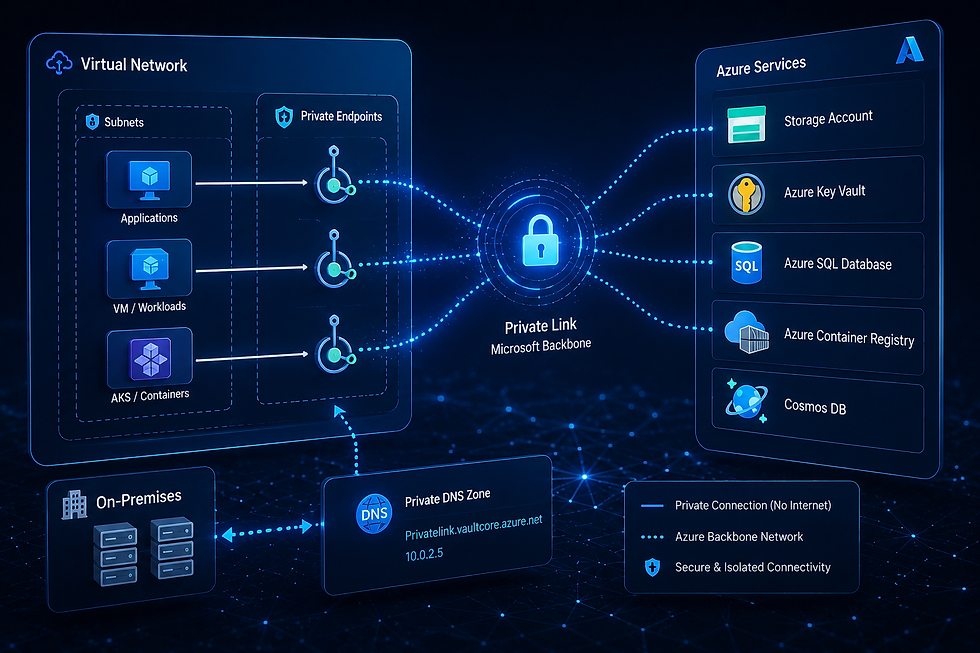
One of the most misunderstood networking features in Microsoft Azure is Private Link and Private Endpoints.
Many organizations implement them because they are considered a security best practice — but few fully understand:
What They Actually Do
How Traffic Flows
Why DNS Matters So Much
Why Connectivity Sometimes Breaks
How They Differ From Traditional Networking
As cloud environments become more security-focused, understanding Private Link architecture is becoming increasingly important for platform engineers, infrastructure teams, and cloud administrators.
This article explains Azure Private Link and Private Endpoints in practical, simplified terms.
What Is Azure Private Link?
Azure Private Link allows services in Azure to be accessed privately over internal Azure networking instead of the public internet.
Normally, many Azure services are accessed using public endpoints.
For example:
Storage Accounts
Key Vaults
SQL Databases
Container Registries
App Services
Even when secured with firewalls or authentication, these services often still expose public-facing endpoints.
Private Link changes this model.
Instead of traffic going over the public internet, Azure creates a private connection directly inside your virtual network.
What Is a Private Endpoint?
A Private Endpoint is the actual network interface created inside your virtual network.
It receives a private IP address from your subnet and acts as the private entry point to an Azure service.
Think of it like:
A private doorway from your VNet directly into an Azure service.
Instead of connecting to:
myvault.vault.azure.net → Public InternetTraffic becomes:
myvault.vault.azure.net → Private IP Inside Your VNetThis is one of the key concepts people often miss:
The service itself is not moved into your VNet
Azure creates a private network interface to the service
Traffic is redirected privately through Azure’s backbone network
How Traffic Actually Flows
This is where confusion usually starts.
Let’s use Azure Key Vault as an example.
Without Private Endpoint:
Application → Public DNS → Public IP → Azure ServiceWith Private Endpoint:
Application → Private DNS → Private IP → Azure Backbone → Azure ServiceThe critical difference is:
DNS now resolves the service to a private IP
Traffic stays internal to Azure networking
Public internet routing is avoided
This is why DNS configuration becomes extremely important.
Why DNS Is So Important
Most Private Endpoint problems are actually DNS problems.
When a Private Endpoint is created, Azure expects DNS to resolve the service hostname to the private IP address.
For example:
Public resolution:
myvault.vault.azure.net → 20.x.x.xPrivate resolution:
myvault.vault.azure.net → 10.x.x.xIf DNS is incorrect:
Applications may still use the public endpoint
Connectivity may fail completely
SSL certificate mismatches may occur
Hybrid environments may behave inconsistently
This is why Azure often creates:
Private DNS Zones
DNS Zone Links
Automatic A Records
during Private Endpoint deployments.
What Azure Services Support Private Endpoints?
Many Azure services support Private Link, including:
Storage Accounts
Azure SQL
Cosmos DB
Key Vault
Azure Kubernetes Service
Azure Container Registry
App Services
PostgreSQL
Service Bus
Event Hub
Each service exposes different sub-resources.
For example:
Storage Accounts may expose:
Blob
File
Queue
Table
Container Registry may expose:
Registry
Data Endpoints
This is why some services require multiple Private Endpoints or additional DNS records.
Why Organizations Use Private Endpoints
The main goal is reducing public exposure.
Private Endpoints help organizations:
Reduce Attack Surface
Enforce Internal Connectivity
Improve Network Segmentation
Meet Compliance Requirements
Restrict Public Access
Improve Security Posture
Many enterprises now disable public network access entirely once Private Endpoints are working correctly.
Common Misunderstandings
“The Service Is Inside My VNet”
Not exactly.
The Azure service itself still exists as a managed platform service.
Azure simply creates a private network path to it.
“Private Endpoint Means No Internet Access Is Needed”
Not always.
Some workloads may still require outbound internet connectivity for:
Updates
Package Repositories
External APIs
Authentication Services
Private Endpoints only affect access to the specific Azure service.
“Private Endpoint Automatically Solves Security”
Private Endpoints improve network security — but they are not a complete security solution.
Organizations still need:
Identity Management
RBAC
Firewall Rules
Monitoring
Logging
Governance
Proper NSG Configuration
Common Problems With Private Endpoints
DNS Misconfiguration
The most common issue.
Incorrect DNS resolution causes:
Timeouts
Certificate Errors
Unexpected Public Routing
Broken Hybrid Connectivity
On-premise systems often cannot resolve Azure private DNS correctly without proper forwarding.
Subnet Design Issues
Private Endpoints consume IP addresses inside subnets.
Poor subnet planning can create scaling problems later.
Service Dependencies
Some Azure services require additional endpoints or supporting services to function correctly.
Incorrect Firewall Expectations
Disabling public access too early can break deployments if DNS or routing is incomplete.
Private Endpoints in Kubernetes Environments
Azure Kubernetes Service environments commonly use Private Endpoints for:
Container Registries
Key Vault
Storage Accounts
Databases
Internal APIs
This improves security significantly — but also increases networking complexity.
Common Kubernetes challenges include:
DNS Resolution Inside Clusters
Private Registry Pull Failures
Managed Identity Connectivity
Hybrid DNS Integration
Private API Routing
Observability becomes extremely important when troubleshooting these environments.
Private Link vs Service Endpoints
This is another area of confusion.
Service Endpoints
Extend VNet identity to Azure services
Traffic still reaches public endpoints
Simpler to configure
Less isolated
Private Endpoints
Use Private IP Addresses
Fully private connectivity
Stronger isolation
More secure
More DNS complexity
Private Endpoints are generally considered the more secure modern approach.
Why Private Networking Matters More Today
As organizations adopt:
Zero Trust Architectures
Hybrid Cloud
Kubernetes
Enterprise Governance
Compliance Frameworks
Private connectivity becomes increasingly important.
Publicly exposed services create:
Larger Attack Surfaces
Increased Compliance Risk
More Complex Firewall Management
Private Link helps organizations create more controlled and secure cloud environments.
Final Thoughts
Azure Private Link and Private Endpoints are powerful networking features that significantly improve cloud security and network isolation.
However, they are often misunderstood because the concepts involve:
DNS
Routing
Managed Services
Internal Azure Networking
Hybrid Connectivity
Once understood correctly, Private Endpoints become much easier to design, troubleshoot, and scale.
The most important thing to remember is this:
Private Endpoints are fundamentally a DNS-driven private routing solution.
Understanding that single concept simplifies much of the architecture.
Need help designing secure Azure networking or troubleshooting Private Endpoint connectivity?
KENNEDY & CO. digital provides Azure infrastructure consulting, Kubernetes platform engineering, hybrid networking, and cloud reliability services for modern businesses.


