Why Companies Choose Kubernetes on Azure for Modern Infrastructure
- May 7
- 4 min read

Modern businesses are under pressure to deliver applications faster, scale reliably, reduce downtime, and maintain stronger security standards — all while controlling cloud costs. Traditional infrastructure models often struggle to meet these demands, especially as environments grow more complex.
This is one of the main reasons organizations are increasingly adopting Kubernetes on Microsoft Azure.
By combining the orchestration capabilities of Kubernetes with the scalability and enterprise ecosystem of Azure, businesses can build platforms that are more resilient, automated, and operationally efficient.
What Is Kubernetes?
Kubernetes is an open-source container orchestration platform designed to automate the deployment, scaling, networking, and management of modern applications.
Instead of manually managing individual servers or virtual machines, Kubernetes allows businesses to run applications in containers across clusters of infrastructure with built-in automation and high availability.
In practical terms, Kubernetes helps organizations:
deploy applications faster
recover automatically from failures
scale services dynamically
standardize environments
simplify infrastructure operations
Why Azure Works Well for Kubernetes
Microsoft Azure provides a strong enterprise-ready ecosystem for Kubernetes deployments through Azure Kubernetes Service (AKS).
AKS removes much of the operational overhead involved in managing Kubernetes clusters manually. Instead of maintaining control plane infrastructure, patching components, or handling complex upgrades yourself, Azure manages large portions of the platform.
This allows engineering teams to focus more on applications and operations rather than infrastructure maintenance.
Key Benefits of Kubernetes on Azure
1. Improved Scalability
Traditional infrastructure often requires overprovisioning resources to handle peak demand. Kubernetes changes this approach by dynamically scaling workloads based on real-time demand.
Applications can automatically scale up during busy periods and scale down when demand decreases, helping businesses:
improve performance
reduce wasted resources
optimize infrastructure costs
This is especially valuable for:
customer-facing applications
APIs
data platforms
industrial monitoring systems
SaaS platforms
2. Higher Availability and Reliability
Downtime can have serious operational and financial consequences.
Kubernetes improves resilience by automatically restarting failed workloads, redistributing traffic, and maintaining application availability across multiple nodes.
Combined with Azure’s infrastructure redundancy and regional capabilities, organizations can achieve highly available architectures that are more resistant to:
hardware failures
software crashes
node outages
deployment issues
3. Faster Application Delivery
Modern development teams need to release updates quickly without introducing instability.
Kubernetes supports modern deployment practices such as:
rolling updates
blue/green deployments
GitOps workflows
automated CI/CD pipelines
This enables businesses to:
reduce deployment risk
accelerate feature delivery
improve operational consistency
standardize deployment processes
4. Better Resource Utilization
Virtual machine environments are often inefficient because workloads are isolated into fixed infrastructure allocations.
Kubernetes schedules workloads more intelligently across available infrastructure, helping organizations maximize utilization while reducing unnecessary compute costs.
For many businesses, this leads to:
lower operational overhead
improved infrastructure density
better cloud cost visibility
5. Stronger Security and Governance
Security remains one of the biggest concerns in cloud environments.
Azure provides integrated security capabilities for Kubernetes environments including:
identity integration
role-based access control
network policies
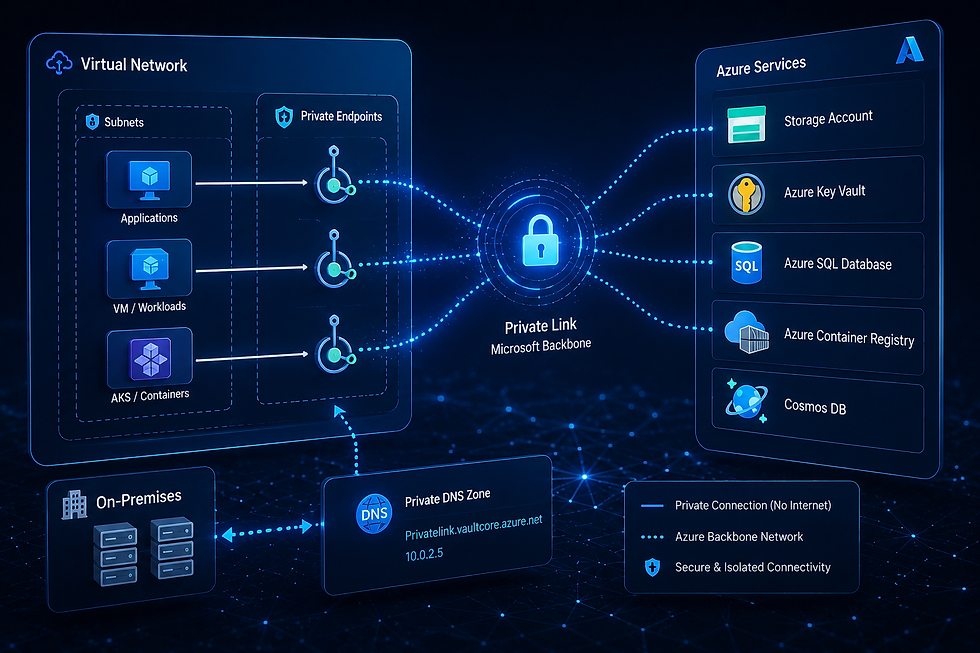
private networking
centralized logging
compliance tooling
secrets management
When implemented correctly, Kubernetes on Azure can provide significantly stronger governance and operational visibility than traditional unmanaged infrastructure.
Common Business Use Cases
Organizations are using Kubernetes on Azure for a wide range of workloads, including:
SaaS Platforms
Scalable multi-tenant applications with automated deployments.
Internal Enterprise Systems
Modernized business applications with improved reliability.
Industrial & SCADA Platforms
Backend systems supporting telemetry, analytics, integrations, and operational visibility.
APIs & Integration Layers
Reliable service communication between business systems.
AI & Data Processing
Containerized workloads that require scalable compute resources.
Challenges Businesses Must Still Solve
Although Kubernetes offers major advantages, it also introduces operational complexity if not designed correctly.
Common issues include:
poor observability
weak networking design
unmanaged cloud costs
security misconfigurations
deployment drift
unreliable scaling
lack of operational governance
This is why platform engineering and operational maturity remain critical for long-term success.
Simply deploying Kubernetes does not automatically create a reliable cloud platform.
The Importance of Observability
One of the most overlooked aspects of Kubernetes adoption is observability.
Traditional monitoring tools often fail to provide sufficient visibility into modern distributed environments.
Organizations need visibility into:
application performance
infrastructure health
logs and metrics
deployment behavior
networking issues
operational anomalies
Without proper observability, diagnosing issues becomes significantly more difficult as environments scale.
Kubernetes Is Becoming the Modern Infrastructure Standard
Many organizations are moving toward Kubernetes because it creates a more standardized and portable operational model.
Rather than relying on manually managed infrastructure, businesses can build platforms that are:
automated
repeatable
scalable
resilient
cloud-native
For companies investing in long-term digital transformation, Kubernetes is increasingly becoming part of the foundational platform strategy.
Final Thoughts
Kubernetes on Azure provides organizations with a powerful foundation for building scalable, resilient, and modern infrastructure platforms.
When designed correctly, it can improve operational reliability, deployment velocity, visibility, and infrastructure efficiency while supporting future growth.
However, successful Kubernetes adoption requires more than simply deploying a cluster. Platform architecture, observability, governance, security, and operational processes all play a major role in long-term success.
Need help designing or stabilizing your Kubernetes platform?
KENNEDY & CO. digital provides cloud platform engineering, Kubernetes operations, observability, and infrastructure reliability services for modern businesses.